
Introduction to Dispersion Blades from Nowak
Dispersion blades play a vital role in high-shear processes such as particle size reduction, emulsification, powder incorporation, and overall product homogenization across industries like coatings, cosmetics, and chemical manufacturing. In simple terms, dispersion blades, also commonly known as sawtooth blades, are mixing tools that rotate at high speeds to break apart particles and evenly distribute solid particles in a liquid base.
The rapid rotary motion of dispersion blades does more than just stirring. It creates a powerful mechanical force that deagglomerates solids, drives uniform flow, and helps ensure every component is effectively blended into a smooth and stable mixture.
How Dispersion Blades Work
Dispersion blades outperform standard impellers and agitators since they operate at significantly higher speeds to generate a powerful shear force.
Terry Sanchez, founder of Nowak Industrial Products, says, “The teeth of the blade rapidly draw ingredients into a central vortex, forcing material through narrow zones where they are then subjected to strong mechanical forces. This breaks apart agglomerates and ensures that solids are not just suspended but efficiently dispersed throughout the liquid. This intense mechanical action results in a homogenous blend of fine, consistently sized particles.”
Laminar Flow vs. Turbulent Flow
The flow created by dispersion blades occurs in a laminar pattern. The fluid layers move parallel to each other in a way that creates minimal turbulence. Laminar flow ensures predictable particle movement toward the trailing edge of the blade to help prevent localized hotspots or excessive mechanical stress and produces even deagglomeration, homogenization, and particle size reduction.
In contrast, turbulent flow is characterized by chaotic, irregular motion, which leads to uneven shear, unpredictable particle trajectories, and areas of excessive mechanical energy. Turbulence risks over-shearing of sensitive materials and introduces air bubbles into the mix. By maintaining laminar flow, dispersion blades ensure controlled shear and uniform particle distribution without damaging the end product.
Nowak Industrial Dispersion Blade Types
Nowak Industrial Products manufactures the three most common styles of dispersion blades. The amount, size, and shape of the teeth of a blade directly affect how well it can shred and disperse solids. Larger and more widely spaced teeth (high-vane) improve the movement of thicker materials but produce less shear. Smaller, closely spaced teeth (high-shear) increase the cutting action, ideal for finer dispersion, but may be less effective at pumping viscous products.

High-Shear Blades from Nowak
High-shear dispersion blades are specialized mixer attachments engineered to generate intense mechanical force – known as shear – inside liquid formulas. When spinning at elevated speeds, the blade quickly tears apart agglomerates and solid particles and distributes them uniformly throughout the mixture. The aggressive geometry of the blade creates smooth, consistent blends with fine particle breakdown, which is crucial in applications like paints, coatings, and adhesives where uniformity is key. These blades typically feature a sawtooth or similarly shaded edge that further accelerates the dispersing action.
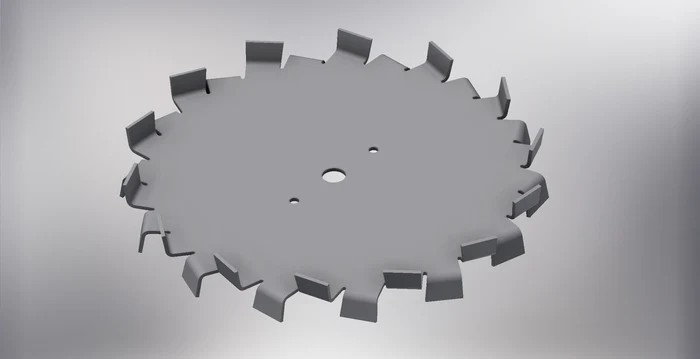
Rectangle-Tooth Blades from Nowak
A rectangle-tooth dispersion blade uses evenly shaped rectangular teeth arranged along the perimeter. Compared to a traditional sawtooth blade, this blade style delivers a stronger pumping effect while generating moderate levels of shear. This balance works especially well with mixtures that are heavier or more viscous, where the circulation of material is just as important as the breaking up of clumps. The straight, consistent tooth profile helps move substantial volumes of product and reduces the chances of clogging since material can easily flow between the teeth while still receiving enough shear for even dispersion.
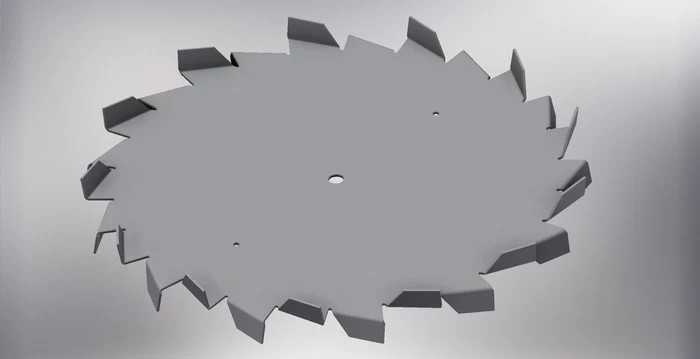
High-Vane Blades from Nowak
High-vane dispersion blades are designed for strong pumping action and are effective for materials or products that require constant movement, such as thixotropic materials.
Nowak Industrial Products manufactures all three of these blade dispersion styles at its facility in Grain Valley, Missouri. Blades are available in a wide range of sizes with various blade mounting configuration options.
In addition to tooth design, blade size is an equally significant performance factor. Choosing the correct blade size ensures the system creates an optimal mixing vortex. This is critical for delivering effective particle breakdown for the volume and viscosity of the product. Industry best practice suggests that a blade should measure roughly one-third the diameter of the mixing tank. Using too large or too small a blade may result in inefficient mixing, wasted energy, or incomplete dispersion.
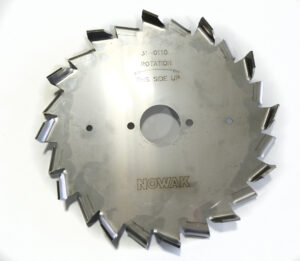
Nowak’s specialized equipment can manufacture both 304 and 316 stainless steel dispersion blades in a wide variety of sizes and blade configurations.
Most dispersion blades are manufactured from 304 or 316 stainless steels, both chosen for their durability and corrosion resistance. These two materials offer distinct advantages depending on the operating environment and the chemistry of the material being processed. 304 stainless steel is the standard choice for most applications, providing reliable strength and corrosion resistance in typical industrial settings. 316 stainless steel offers superior resistance to corrosion – particularly in acidic, saline, or sulfur-rich environments, such as those found in fertilizers, specialty chemicals, and certain food products. Nowak Industrial Products provides both 304 stainless steel and 316 stainless steel dispersion blade options.
Selecting the Right Dispersion Blade
Several considerations must be made while determining the right blade for the job:
- The viscosity of the material being mixed. Thicker products will need bigger or differently shaped blades.
- The size of the batch being mixed. The blade should be proportionally matched to the tank in which the mixing is taking place.
- The required level of shear versus the need for circulation. Some processes will demand more particle breakup, while others will require more effective bulk movement.
For assistance in choosing the right dispersion blade size for your specific industrial application, send the Nowak Industrial team a message online!
Role in Paint and Coating Manufacturing
Dispersion blades are critical tools for paint and coating production. Achieving consistent particle size, uniform distribution, and optimal flow directly impacts product performance, appearance, and shelf life.
Common raw materials like titanium dioxide, iron oxides, and pigments naturally form clusters. Dispersion blades break down these clumps efficiently to ensure each particle is individually suspended within the medium. Beyond just solids, dispersion blades also evenly distribute resins, solvents, additives, and defoamers. As dispersion blades employ laminar flow, all components are thoroughly integrated, and localized concentration variations are avoided.
Thorough dispersion is critical for paints and coatings to resist settling, flocculation, and separation during storage. It directly improves application smoothness, consistency, and overall shelf life of the product, helping to reduce waste and ensuring reproducible batches.
Operational Best Practices and Long-Term Performance
Reliable dispersion depends on both precise operation and consistent maintenance of the blades. One such operational consideration is maintaining the optimal vortex depth within the tank.
Blade speed must also be adjusted throughout the mixing cycle. During the initial high-shear phase, the blade applies maximum energy. Once the material reaches the desired level of dispersion, blade speed is then reduced for gentle homogenization and to avoid excessive mechanical strain.
Maintenance of blades is equally important for the long-term performance of blades and consistent results:
- Blades should be inspected regularly for wear, corrosion, cracks, or dull teeth.
- Blades should be cleaned to prevent any material from building up and hardening on the blade, which reduces efficiency over time.
- Careful attention must be given to proper assembly and handling to prevent accidental damage.
- Mixers and motors should be properly maintained so that blades are not subjected to excessive vibration that could cause premature failure.
In summary, dispersion blades are essential tools in industrial mixing and play a critical role in particle size reduction, homogenization, and efficient incorporation of materials across dozens of industries. Their performance and longevity rely on careful selection, proper operation, and routine maintenance. Choosing the right blade design, size, and material for specific applications ensures manufacturers can achieve optimal particle dispersion, consistent product quality, and efficient processing. Adhering to the best industry practices not only maximizes blade life and reduces downtime but also allows for reproducible results across a wide range of industrial mixing and high-shear applications.
